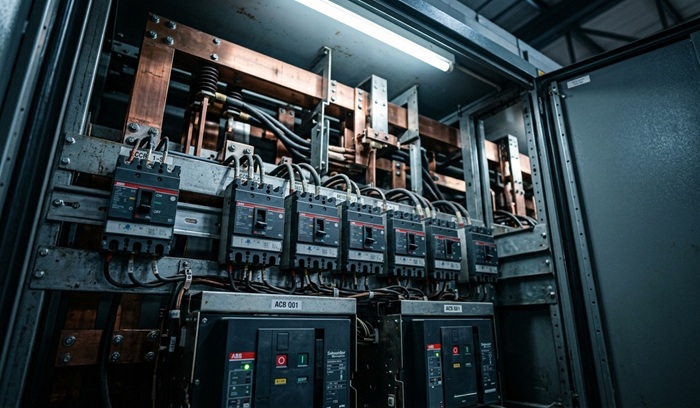
What Does "Breaker Fault Capacity" Actually Mean?
Breaker fault capacity refers to the maximum fault current a circuit breaker can safely interrupt without damage to itself or connected equipment. It is expressed in kiloamperes (kA) and appears as the rated short-circuit breaking capacity (Ics) or ultimate breaking capacity (Icu) on the nameplate. IEC 60947-2 governs both ratings for low-voltage circuit breakers.
Most industrial facilities commission a breaker, install it, and never verify it again. But the fault current your switchgear sees today may be meaningfully different from what it saw at commissioning. Transformer upgrades, DG additions, grid tie-ins, and new load connections all change the prospective short-circuit current at every bus in your system.
Breaker fault capacity is not a fixed safety buffer. It is a calculated value that must be verified against your system's current configuration. If it has not been reviewed since commissioning, it probably needs to be.
A breaker is considered adequate when its Ics rating equals or exceeds the prospective short-circuit current (PSCC) at its point of installation, under all operating modes.
How Is the Prospective Short-Circuit Current Calculated?
PSCC is calculated using a short circuit analysis conducted per IEC 60909. The method accounts for all fault current sources: the utility grid, on-site transformers, captive generation, and synchronous motors running in parallel. Operating mode matters significantly — PSCC must be evaluated across all plausible scenarios, not just the base case.
In a short circuit study conducted for a chemical plant at Lote MIDC, Maharashtra, the 3-phase fault current at the LT bus varied considerably across three operating modes. A breaker validated only against the lowest mode would be undersized when the DG comes online — a common real-world gap.
| Operating Mode | Source Configuration | 3-Phase Fault Current (LT Bus) |
|---|---|---|
| Captive Float Mode | Grid + DG (parallel) | 9.73 kA |
| Grid-Only Mode | Grid supply only | 9.05 kA |
| Captive-Only Mode | DG set only | 0.98 kA |
Source: SAS Powertech ETAP Power System Study — Lote MIDC Chemical Plant. Fault current varies by nearly 10× across operating modes. Settings validated at 0.98 kA are critically undersized when grid and DG run in parallel at 9.73 kA. This is why multi-mode analysis per IEC 60909 is the only credible verification method.
ETAP-based simulation is the standard tool for this analysis in multi-source industrial systems. It models transformer impedance, generator sub-transient reactance, motor contributions, and cable impedance — producing verified fault current values at every bus across every operating scenario.
Key Indicators That Your Breaker Fault Capacity May Be Insufficient
There is no single visual indicator that directly flags an undersized breaker during normal operation. However, certain system changes raise the risk significantly and warrant a formal review before the next fault event reveals the gap.
Addition of a new transformer or DG set to the system
Grid connectivity changes — new utility feeder or substation upgrade
Addition of large synchronous motors contributing fault current
Distribution system expansion without a corresponding protection review
Changes in source impedance at the incoming supply point
No short circuit study update since last major system change
Additionally, breakers that have interrupted high-level faults in the past may have degraded mechanical integrity. Their nameplate rating remains unchanged, but their actual performance under fault conditions may be reduced. Periodic testing per manufacturer guidelines and IS 18732 is required to detect this — nameplate review alone is not sufficient.
"Breaker fault capacity is not a commissioning-only verification. Every significant source addition or system change is a trigger to review whether existing switchgear ratings remain adequate."
SAS Powertech Pvt. Ltd. — Power System Protection Engineering PracticeWhat Do the Standards Require?
Breaker fault capacity verification is not discretionary. Multiple Indian and international standards establish it as a compliance obligation, each covering a different dimension of the requirement.
Indian Statutory Requirement
Protective devices must be maintained in correct working condition with ratings appropriate for the system. Capacity verification is a documented obligation — not a discretionary activity.
Short-Circuit Current Calculation
Provides the calculation methodology for prospective short-circuit currents in three-phase AC systems. This is the engineering basis for all breaker fault capacity verification work.
LV Circuit Breaker Ratings
Defines Ics (service breaking capacity) and Icu (ultimate breaking capacity) for low-voltage circuit breakers. Ics is the value that must be verified against PSCC for operational compliance.
Protection Against Fault Currents
Requires that protective devices be capable of disconnecting fault currents without endangering personnel or equipment. Device capacity must be verified against actual system fault levels.
Indian Electrical Safety Practices
Requires that protective device ratings be verified against actual system fault levels and documented as part of the electrical safety compliance framework for industrial facilities.
Arc Flash Incident Energy
Fault clearance time — determined by breaker performance — is a direct input to arc flash incident energy calculation. An undersized breaker that fails to operate correctly invalidates arc flash boundary assessments.
A breaker operating beyond its rated breaking capacity is a statutory non-compliance — not just an engineering concern. CEA Safety Regulations 2023 require that protective devices be maintained with ratings appropriate for the system they protect.
Under IS 18732, Indian industrial facilities are obligated to verify protective device ratings against actual system fault levels and document this as part of their electrical safety compliance framework. Operating a facility with breakers rated below the system's PSCC carries legal exposure under the Indian Electricity Rules in addition to the physical safety risk.
What Happens When Breaker Fault Capacity Is Exceeded?
When fault current exceeds a breaker's rated breaking capacity, the breaker may fail to interrupt the fault. The arc may not be extinguished. In severe cases, the enclosure fails — releasing ionised plasma into the surrounding environment. This is an arc flash event, and its incident energy is directly proportional to fault clearance time.
The consequences are mechanical and thermal. An undersized breaker that fails to operate correctly extends fault clearance time — dramatically increasing arc flash energy at the point of fault. Under IEEE 1584-2018, fault clearance time is a direct input to arc flash incident energy calculation.
An uncoordinated or capacity-exceeded fault event at the breaker point invalidates the arc flash boundary and PPE category assigned to that location. Personnel working on or near the affected panel are exposed to incident energy levels that their PPE was not rated to withstand.
- Failure to interrupt the fault — the breaker cannot clear a fault current above its rated breaking capacity, leaving the fault energised.
- Arc flash event at the switchgear — unextinguished arcing in the panel releases ionised plasma, creating a severe burn and blast hazard for nearby personnel.
- Extended fault clearance time — directly increases arc flash incident energy per IEEE 1584-2018, potentially exceeding PPE category limits for that work location.
- Mechanical breaker failure — explosive failure of the breaker enclosure due to internal arc, with potential for cascade faults in adjacent equipment.
- Invalidated arc flash study — a breaker that cannot operate within its designed parameters makes the arc flash incident energy calculation for that location unreliable.
- Statutory non-compliance exposure — failure to maintain adequate protective device ratings is a violation of CEA Safety Regulations 2023, carrying legal liability.
When a Professional Fault Capacity Review Becomes Necessary
A professional breaker fault capacity review becomes necessary after transformer upgrades, DG additions, utility source changes, switchgear expansion, or any major change that can alter prospective short-circuit current levels. Nameplate verification alone is not sufficient in such cases — the PSCC at each bus must be recalculated against the current system configuration.
Where system fault levels exceed installed breaker ratings, a professional engineering review defines the most suitable corrective approach — whether that involves breaker replacement, bus sectionalisation, current-limiting reactors, or adjustments to source impedance — without compromising coordination and safety margins.
Explore SAS Powertech's Short Circuit Analysis Services to understand how PSCC is verified across operating modes, and how breaker ratings are assessed against current system data for CEA compliance readiness.
Check where your facility stands. A short circuit study conducted per IEC 60909 confirms whether your installed breakers remain adequate — and provides the engineering documentation required under CEA Safety Regulations 2023.
Request a Study →Conclusion
Breaker fault capacity verification is not a commissioning-only activity. System changes, source additions, and grid upgrades can all increase the fault current at installed switchgear — sometimes without the facility's protection team being formally notified.
A short circuit study, conducted per IEC 60909 and reviewed against current system data, is the only reliable method to confirm that your breakers remain adequate. It also forms the foundation for relay coordination settings and arc flash calculations — the three studies are technically interdependent.
If your facility's short circuit study has not been updated since the last major system change, the protection ratings it was based on may no longer apply.
"Nameplate rating confirms design capability. It does not confirm that the capability is adequate for the fault current at that location today. That requires a study."
SAS Powertech Pvt. Ltd. — Independent Electrical Safety & Power System Engineering ConsultancyFrequently Asked Questions
Get a Professional Assessment of Your Protection System
SAS Powertech conducts independent, ETAP-based short circuit studies for industrial and commercial facilities across India. Our reports are structured to serve as technical evidence for CEA compliance and Electrical Safety Audit purposes.
Independent Electrical Safety & Power System Engineering Consultancy
SAS Powertech is an independent electrical safety and power system engineering consultancy with over 25 years of experience across industrial and commercial facilities in India, the Middle East, Southeast Asia, and Africa.
Services include Electrical Safety Audits, Arc Flash Analysis, Relay Coordination Studies, Short Circuit Analysis, Power Quality Audits, Load Flow Analysis (ETAP-based), and Root Cause Electrical Failure Analysis.