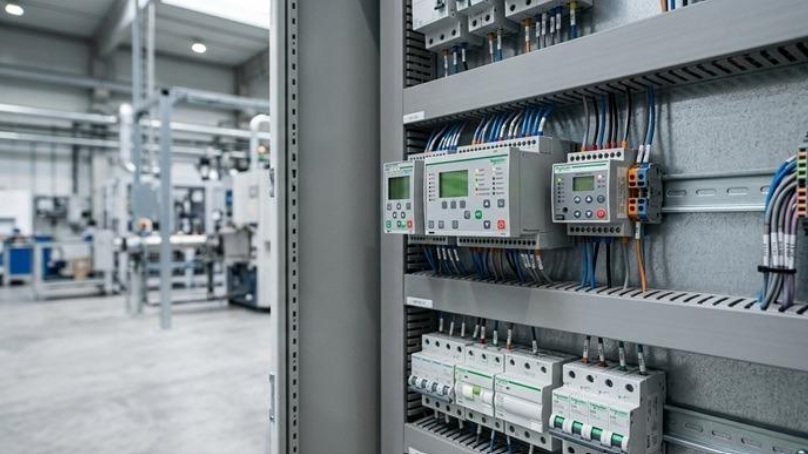
What Is Relay Coordination?
Relay coordination is the process of configuring protective devices — overcurrent relays, circuit breakers, fuses — so each one trips in a defined time sequence during a fault. The device nearest the fault operates first. Upstream devices act only if the downstream device fails to clear the fault within its allotted time window.
Coordination depends on four core properties of any protection system. Selectivity is the most critical. It ensures only the device closest to the fault responds first, isolating the faulted section while the rest of the plant continues to operate.
Selectivity
Only the device nearest the fault responds first, isolating that section while healthy parts of the plant remain energised.
Speed
Faster fault clearance reduces equipment damage, arc flash energy, and the duration of voltage dips affecting the wider network.
Sensitivity
Protection must detect the minimum fault current reliably — including in low-fault-current operating modes such as captive-only generation.
Stability
Protection must remain stable under normal load conditions — motor starting currents, transformer inrush — and not operate unnecessarily.
Devices in the coordination chain include overcurrent relays, MCBs, ACBs, VCBs, and fuses. Each has its own time-current characteristic. Coordination aligns these so no two devices compete for the same fault event.
Why Is Relay Coordination Required?
Relay coordination is required because an uncoordinated protection system cannot isolate only the faulted section. It is mandated under CEA Safety Regulations 2023 and IEC 60255, and directly determines arc flash risk levels and nuisance trip behaviour. Without a formal coordination study, protection settings have no verified engineering basis.
When protective devices are not coordinated, a fault in one section causes an upstream breaker to trip before the device nearest the fault. Power is cut to healthy equipment. The fault remains energised. The outage is wider than necessary — and the root cause is still present.
Upstream breaker trips before the fault device — widening the outage
Fault remains energised — increasing arc flash exposure duration
Healthy plant sections lose power unnecessarily — production disruption
Nuisance tripping on normal load events — motor starting, transformer inrush
No verified engineering basis for protection settings — compliance gap
Extended fault clearance time — higher incident energy per IEEE 1584-2018
Nuisance tripping follows the same failure pattern. Relay settings adjusted during maintenance, without a follow-up study, often result in devices that can no longer discriminate between a transient motor starting current and a sustained fault condition. The outcome is either an unwanted trip on normal load, or a delayed trip on an actual fault.
Fault clearance time — controlled by relay coordination — feeds directly into arc flash incident energy calculations under IEEE 1584-2018. Longer clearance time means higher incident energy at the fault point, increasing risk for personnel working near energised equipment.
"In power system networks, protection must be designed so that protective relays isolate the faulted portion of the network — preventing equipment damage and operator injury, while ensuring minimal system disruption."
SAS Powertech Pvt. Ltd. — Power System Protection Engineering PracticeWhat Standards Make It a Requirement?
Relay coordination is not discretionary in industrial facilities. Multiple Indian and international standards establish it as a compliance obligation — each covering a different dimension of the requirement.
Indian Statutory Requirement
Protection systems must be maintained in correct working condition, with settings documented and periodically verified. A relay coordination study provides the engineering basis for this obligation.
Relay Characteristic Curves
Defines IDMT and other relay curves that form the basis of time-current grading in any coordination study. Device settings must conform to these defined characteristics.
Short-Circuit Current Calculation
Governs fault current calculation — the primary input to relay coordination settings. No coordination study can be credible without a preceding short-circuit analysis per this standard.
Arc Flash Incident Energy
Uses fault clearance time — set by relay coordination — as a direct input to arc flash incident energy calculation. Coordination quality directly determines PPE requirements and working boundaries.
Indian Electrical Safety Practices
Covers protection system maintenance obligations for industrial facilities, including requirements for documentation of settings and operational verification.
Low Voltage Installation Safety
Establishes protection requirements for LV systems, including device coordination as a design requirement for overload and short-circuit protection.
Check where your facility stands in protection system compliance. A professional relay coordination study confirms whether your protection settings reflect current system configuration and meet applicable standards.
Connect with Experts →How Are Relay Coordination Settings Determined?
Settings are derived from a short-circuit study (per IEC 60909) and time-current characteristic (TCC) analysis. Fault current values at each bus are calculated across all operating modes. Device curves are plotted on a log-log TCC graph, and settings are selected so curves do not overlap — ensuring the downstream device always clears the fault first.
Operating mode matters significantly. In a chemical plant project at Lote MIDC, Maharashtra, the 3-phase fault current at the LT bus varied across three modes. Settings validated at peak fault current behave differently at lower fault levels — particularly in captive-only mode. A credible coordination study accounts for all operating scenarios.
| Operating Mode | Source Configuration | 3-Phase Fault Current (LT Bus) |
|---|---|---|
| Captive Float Mode | Grid + DG (parallel) | 9.73 kA |
| Grid-Only Mode | Grid supply only | 9.05 kA |
| Captive-Only Mode | DG set only | 0.98 kA |
Source: SAS Powertech ETAP Power System Study — Lote MIDC Chemical Plant. Fault current at the LT bus varies by nearly 10× across operating modes, demonstrating why multi-mode coordination analysis is essential for credible protection settings.
ETAP-based simulation handles this complexity for multi-source, multi-bus systems, modelling IDMT relay curves alongside transformer inrush, motor starting, and equipment damage curves across every mode. The output is a set of verified, mode-specific relay settings with supporting TCC documentation.
One-line diagrams with all protective devices mapped across the distribution network.
Time-current characteristic (TCC) curves for each device, plotted on a log-log graph, confirming non-overlapping coordination bands.
Relay setting tables with pickup current, time dial, and curve type for each overcurrent relay in the coordination chain.
Multi-mode validation confirming settings hold across all operating configurations — grid-only, captive-only, and parallel modes.
When Should a Relay Coordination Study Be Carried Out?
In practice, coordination is rarely revisited after initial commissioning. Equipment is added over time. Settings are adjusted during shutdowns without a formal study. The plant then operates with a protection scheme that no longer reflects its actual system configuration — a condition that is common, often undetected, and typically only identified after a fault event exposes it.
- At initial commissioning — every new installation requires a baseline coordination study before energisation.
- After new load additions — additional feeders, motors, or distribution boards alter fault current distribution and may invalidate existing settings.
- After transformer rating changes or upgrades — transformer impedance directly affects available fault current at every downstream bus.
- After DG set commissioning or capacity changes — adding a captive source introduces a new fault current contribution that changes coordination requirements throughout the system.
- After relay setting modifications during maintenance — settings changed without a supporting study are an engineering assumption, not a verified configuration.
- On recurring nuisance trips or upstream breaker operations — these are symptomatic of a coordination failure and warrant a full review of existing TCC settings.
- As part of a periodic Electrical Safety Audit — CEA Safety Regulations 2023 require that protection settings be documented and periodically verified.
Frequently Asked Questions
Get a Professional Assessment of Your Protection System
SAS Powertech conducts independent, ETAP-based relay coordination studies for industrial and commercial facilities across India. Our study reports are structured to serve as technical evidence for CEA compliance and Electrical Safety Audit purposes.
Independent Electrical Safety & Power System Engineering Consultancy
SAS Powertech is an independent electrical safety and power system engineering consultancy with over 25 years of experience across industrial and commercial facilities in India, the Middle East, Southeast Asia, and Africa.
Services include Electrical Safety Audits, Arc Flash Analysis, Relay Coordination Studies, Short Circuit Analysis, Power Quality Audits, Load Flow Analysis (ETAP-based), and Root Cause Electrical Failure Analysis. Each engagement is executed by subject matter experts using ETAP simulation tools and calibrated field instruments.